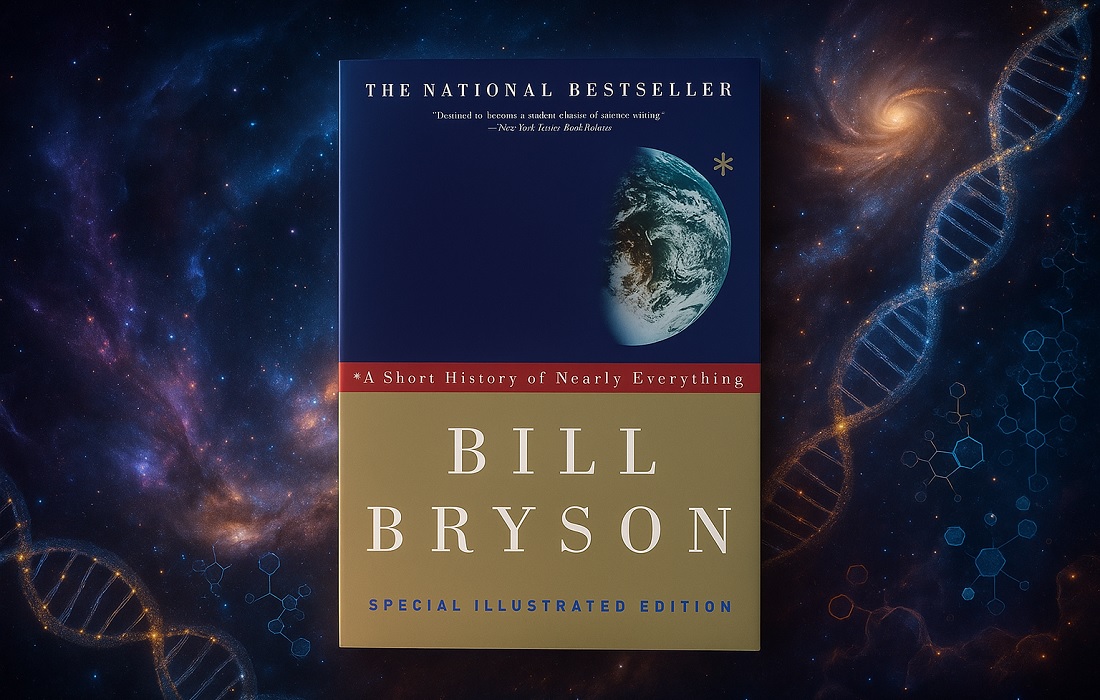
A Short History of Nearly Everything by Bill Bryson is a captivating exploration of the universe’s greatest mysteries, from the Big Bang to human evolution. With humor, clarity, and insatiable curiosity, Bryson guides readers through astronomy, geology, biology, and anthropology, revealing how centuries of science have shaped our understanding of existence. Alongside the big discoveries, he uncovers the human stories, the accidents, rivalries, and persistence, behind them. This isn’t just a catalog of facts; it’s a narrative of wonder and improbable survival. Bryson’s work invites readers to see science not as remote knowledge, but as an exciting, shared human adventure.
1. Introduction to A Short History of Nearly Everything by Bill Bryson
A Short History of Nearly Everything by Bill Bryson is ambitious, witty, and accessible journey through some of the biggest questions science has ever asked – and sometimes answered – about our universe, our planet, and ourselves. Spanning cosmology, geology, chemistry, paleontology, biology, and anthropology, Bryson bridges the daunting gap between the scientific community and a general readership by blending rigorous research with humor, personal reflection, and narrative drive.
Where many science books aim to teach isolated facts, Bryson aims to narrate the story of existence – how the universe came into being from nothing, the way the Earth formed and evolved, how life arose and diversified, and how the particular species we call Homo sapiens became possible. His guiding question is deceptively simple: How do scientists know what they know? He pursues this through interviews, immersion in scholarly works, and conversations with patient experts who helped him translate decades of discovery into an engaging account for a lay audience.
The book is divided into six major parts, each containing chapters that focus on distinct yet interconnected topics: the cosmos, the Earth, life, and the emergence of humans. The scope is immense, yet Bryson’s trademark style – curious, amused, and clear – turns what might be overwhelming into a narrative that is both educational and pleasurable.
2. Author Biography: Bill Bryson
– Full Name: William McGuire Bryson
– Born: December 8, 1951, Des Moines, Iowa, USA
– Nationality: American-British
– Career Path: Bryson began as a journalist working for several newspapers before moving to the UK, where he rose to prominence through travel writing and memoirs (Notes from a Small Island, A Walk in the Woods).
– Writing Style: Known for humor, observational wit, and an ability to make complicated topics accessible.
– Notable Works Beyond Science: Travel literature, language books (e.g., The Mother Tongue), and social history (At Home: A Short History of Private Life).
– On Science Writing: A Short History of Nearly Everything marked a significant thematic departure for Bryson, requiring years of research and expert consultation. It became one of his most celebrated works, winning the Aventis Prize for Science Books and the Descartes Prize for science communication.
Bryson approached the project as a non-scientist with deep curiosity, treating the reader as an intellectual companion rather than a passive audience. His outsider perspective helped frame questions often overlooked by specialists but central to public understanding.
3. Structure of the Book A Short History of Nearly Everything by Bill Bryson
The book is organized into six main parts:
- Lost in the Cosmos – Origins of the universe and our place in it.
- The Size of the Earth – Scientific milestones in measuring our planet and understanding its composition.
- A New Age Dawns – Advances in atomic theory, chemistry, and the birth of modern physics.
- Dangerous Planet – Geological hazards and the volatile nature of Earth.
- Life Itself – The origin and evolution of life, from cells to complex organisms.
- The Road to Us – Human evolution, anthropology, and the fragility of our species’ existence.
Each section blends historical narrative (how scientific understanding evolved) with explanations of the science itself, while sprinkling in quirky anecdotes and human drama behind the discoveries.
4. Part I – Lost in the Cosmos
A Short History of Nearly Everything by Bill Bryson begins with a mind-bending look at the Big Bang and the origins of everything. He walks the reader through the incomprehensible smallness of subatomic particles – for instance, how countless protons could fit in a dot of ink – and then shows how all known matter once existed in a singularity of no dimensions. In an instant known as t = 0, the universe began expanding, creating time and space themselves.
He recounts the accidental discovery of cosmic background radiation by Arno Penzias and Robert Wilson in 1965, which served as critical evidence for the Big Bang model. The tale is laced with humor – their Nobel-winning find was initially an annoying hiss in their antenna, partly blamed on pigeon droppings.
Bryson emphasizes uncertainties: the exact age of the universe, the mysterious nature of dark matter and dark energy, and the improbability of such finely tuned cosmic conditions allowing stars, planets, and life to emerge at all. He conveys both the grandeur and fragility of existence: the odds against atoms and forces arranging themselves into something that could think and write a book are astronomically high.
5. Part II – The Size of the Earth
This section moves from the cosmos to our planetary home. Bryson celebrates the ingenuity of early scientists like Eratosthenes, who estimated Earth’s circumference in the third century BCE using shadows and geometry, and 18th-century surveyors who refined measurements against enormous logistical odds.
He details the work of geologists and physicists in determining Earth’s age – a quest fraught with false starts and revisions. Lord Kelvin once calculated the planet was a mere 20 million years old based on heat loss, ignoring radioactive decay (then unknown), while later geologists and radiometric dating expanded the age to approximately 4.54 billion years.
There’s also exploration of plate tectonics – once considered fringe but now fundamental to geology – explaining how the movement of Earth’s crust shapes mountains, earthquakes, and continents. Bryson’s telling reveals both the stubbornness and adaptability of science: wrong ideas can dominate until new evidence forces change.
6. Part III – A New Age Dawns
Here Bryson turns to the world of the atom and the revolutions of 19th- and 20th-century physics.
He recounts the discovery of elements and the creation of the periodic table by Dmitri Mendeleev, who not only organized known elements but predicted ones yet to be found. There are rich sketches of characters like Marie Curie and Ernest Rutherford, showing science as a human enterprise of brilliance, eccentricity, and occasional recklessness.
The narrative covers the birth of quantum mechanics and Einstein’s theories of relativity, which redefined concepts of time, space, and energy. Bryson is attentive to the paradox of modern physics: it yields incredibly precise predictions yet forces us to accept deeply counterintuitive realities about the nature of matter and light.
7. Part IV – Dangerous Planet
A Short History of Nearly Everything by Bill Bryson shifts focus to the volatile geology of Earth. Topics include:
– Supervolcanoes: Yellowstone sits atop a massive, potentially catastrophic chamber of magma.
– Earthquakes: Unpredictable and often devastating, despite advanced monitoring.
– Asteroid impacts: The extinction of the dinosaurs likely caused by a large asteroid 65 million years ago, leaving the Chicxulub crater.
He frames Earth as both life-giver and destroyer – a planet whose dynamism sustains habitability but also harbors forces capable of wiping life out in moments. Importantly, human civilization has arisen during an unusually calm geological period, making our stability an anomaly rather than the norm.
8. Part V – Life Itself
This expansive section tells the story of life from its smallest building blocks to the diversity of the biosphere.
Origins of Life
Bryson explores theories about how non-living chemicals formed the first living organisms. From the primordial soup hypothesis to deep-sea hydrothermal vents, scientists still debate the exact mechanisms. What is clear is that life appeared relatively soon after Earth cooled enough to sustain it.
Cellular Complexity
Single-celled organisms reigned for billions of years. Bryson describes the symbiotic events that likely led to eukaryotic cells (containing nuclei) and eventually multicellular life.
Evolutionary Milestones
Natural selection, as articulated by Darwin and expanded by modern genetics, explains life’s diversification. Bryson recounts mass extinctions – catastrophic resets that, paradoxically, open opportunities for entirely new forms to flourish.
Biodiversity’s Fragility
Despite life’s resilience over billions of years, species survival is precarious. The fossil record suggests over 99% of all species that have ever lived are now extinct. The modern biodiversity crisis underscores this vulnerability, with human activity accelerating loss rates far beyond natural baselines.
9. Part VI – The Road to Us
The final section brings the narrative to human origins.
Bryson traces our lineage through primates, hominins, and ultimately Homo sapiens. He highlights discoveries from paleoanthropology, such as Australopithecus afarensis (“Lucy”), Homo habilis, and Homo erectus, noting migrations out of Africa and adaptive ingenuity. The fossil trail is fragmentary, and scientific debates over classification remain lively.
Importantly, Bryson stresses the improbability of our species’ survival: climatic shifts, environmental constraints, and sheer bad luck could have easily erased us. Our existence depends on a long chain of fortunate biological and geological events.
10. Key Themes and Insights
Science as a Human Enterprise
– Far from being a seamless march toward truth, science progresses through trial, error, personality clashes, and serendipity.
– Many breakthroughs (cosmic background radiation, penicillin) were stumbled upon accidentally.
Interconnectedness
– The history of the universe, Earth, life, and humans form a single continuum. Changes in one domain (e.g., asteroid impacts) ripple across biology, climate, and evolution.
Humility in Knowledge
– Each chapter underscores how much remains unknown: dark energy, the exact triggers of life’s origin, the deep structure of the proton.
– We live in a “known unknowns and unknown unknowns” landscape.
Fragility of Life
– The universe is not naturally friendly to life. Earth’s habitability depends on narrow physical balances and random events.
The Wonder of Existence
– Despite its hazards and improbabilities, the fact that matter coalesced into creatures capable of contemplating their own origins is extraordinary.
11. Integration with Contemporary Context
Since the book’s first publication in 2003, some details have been refined:
– Cosmology: More precise measurements from probes like Planck have adjusted the estimated age and composition ratios of the universe.
– Planetary Science: Improved asteroid tracking has enhanced hazard assessment.
– Paleogenetics: Ancient DNA analyses have illuminated human interbreeding with Neanderthals and Denisovans.
Bryson’s narrative holds up, however, because it is structured around processes and questions rather than transient numbers – and because his central plea for wonder and curiosity remains evergreen.
12. Critiques and Counterpoints
While widely praised, the book has had some critiques:
– Breadth vs. Depth: Its strength in synthesizing diverse topics leaves little room for deeply technical explanations, which some advanced readers might desire.
– Selective Focus: Some disciplines, such as environmental science or contemporary technology, appear mainly in passing.
– Historical Condensation: Complex scientific debates are necessarily simplified, which may smooth over ongoing controversies.
Nonetheless, for a general audience, these are often trade-offs that enhance readability without distorting central messages.
13. Enduring Value
The key achievement of A Short History of Nearly Everything by Bill Bryson is that it makes the reader feel like an empowered participant in science’s grand narrative. By grounding cosmic-scale concepts in concrete images, human stories, and approachable language, Bryson removes intimidation while preserving awe.
The book’s multidisciplinary span also models an essential truth: understanding our world requires crossing boundaries between physics, chemistry, geology, biology, and history. Bryson demonstrates that curiosity is the common thread linking all the sciences, and that the greatest barrier to public understanding is not intelligence but interest – an interest that can be cultivated with good storytelling.
14. Conclusion
A Short History of Nearly Everything by Bill Bryson delivers exactly what the title promises – not a complete compendium of knowledge, but an engaging, joyous traversal of the major scientific ideas that explain our existence.
Through stories of the universe’s birth, Earth’s shaping, life’s rise, and our improbable survival, Bryson consistently returns to his core fascination: not just what we know, but how we came to know it. The result is a popular science masterpiece that invites readers to marvel at the improbable chain of events that led to “you, here, now,” and to appreciate the unending human quest to understand everything from the smallest subatomic particle to the broad sweep of cosmic history.
It is a work that entertains as it educates, encouraging a mindset of curiosity, humility, and gratitude – gratitude that, against the odds, we find ourselves in a universe that allows life to exist at all, and minds to ponder why.
If you found this summary helpful, please share it or leave a comment below.