
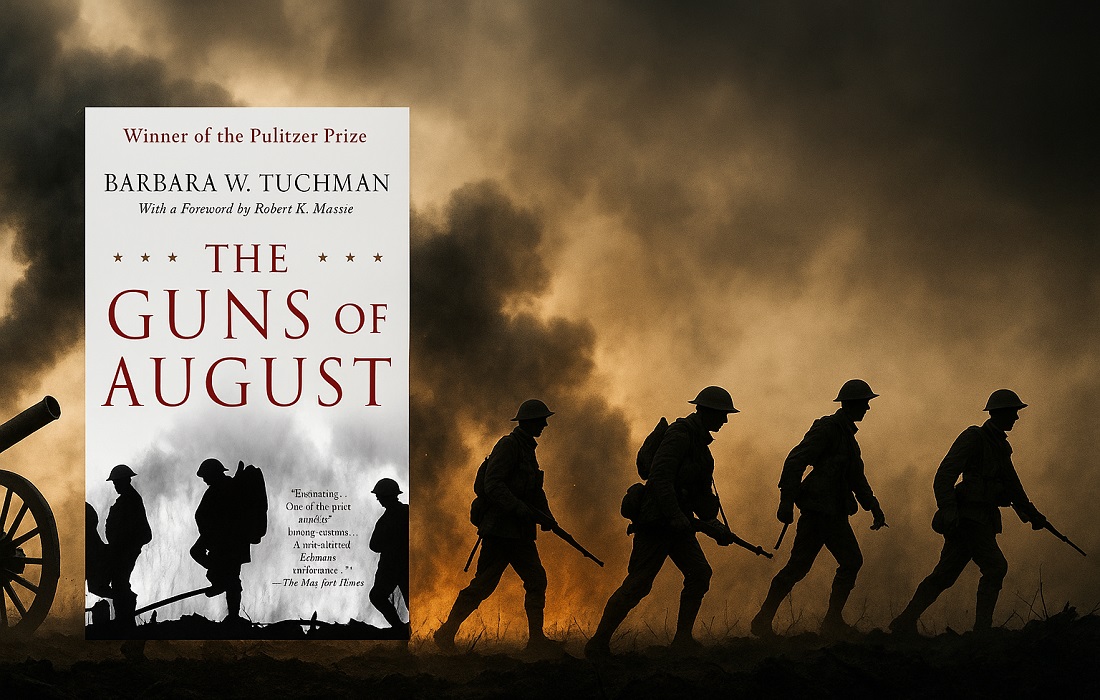
The Guns of August by Barbara W. Tuchman is a Pulitzer Prize winning history of the tense, tragic first month of World War I. With the skill of a novelist and the rigor of a historian, Tuchman brings to life the decisions, personalities, and fatal miscalculations that propelled Europe from uneasy peace into catastrophe. From the grandeur of King Edward VII’s funeral to the thunder of the Marne, she reveals how rigid war plans, political pride, and human folly sealed the course of history. Vivid, gripping, and deeply human, this masterpiece remains a timeless warning about the dangers of escalation and hubris.
1. Introduction to The Guns of August by Barbara W. Tuchman
Published in January 1962, The Guns of August is Barbara W. Tuchman’s magisterial narrative of the war’s first month, when decisions made within a few electrifying weeks in 1914 determined the shape of conflict for the next four years – and arguably the fate of the 20th century.
Unlike traditional military histories that delve into troop compositions, weaponry, and tactical minutiae, Tuchman frames August 1914 as a study of human decision-making under extreme pressure, analyzing the political, cultural, and psychological forces that propelled Europe from uneasy peace into catastrophic war. She unspools events with a novelist’s pacing but a historian’s rigor, vividly portraying monarchs, generals, diplomats, and ordinary soldiers alike.
The book became a literary and political phenomenon:
– It won the Pulitzer Prize for General Non-Fiction in 1963.
– It was widely read by state leaders, notably U.S. President John F. Kennedy, who reportedly used its lessons during the Cuban Missile Crisis to avoid a similar spiral into war.
Tuchman’s enduring message is that history is not inevitable – it is made by flawed individuals responding to incomplete information, ego, and habit. The Guns of August by Barbara W. Tuchman thus offers not just a chronicle of war, but an anatomy of human folly.
2. Author Biography
Barbara W. Tuchman (1912–1989) was an American historian and journalist renowned for making complex international histories accessible to general audiences without sacrificing scholarly credibility.
Early Life & Education
– Born Barbara Wertheim in New York City into a prominent family with political and diplomatic connections (her grandfather Henry Morgenthau Sr. served as U.S. Ambassador to the Ottoman Empire).
– Educated at Radcliffe College; bypassed her graduation ceremony to attend a key economic conference in London.
Career Path
– Worked briefly as a research assistant in Tokyo and reported from the Spanish Civil War for The Nation.
– Married Dr. Lester Tuchman in 1940; raised three daughters while writing her first historical volumes, Bible and Sword (1956) and The Zimmermann Telegram (1958).
Research & Method
– Eschewed formal academic credentials (she never pursued a Ph.D.), which she believed preserved her narrative freedom and style.
– Relied on exhaustive archival research, battlefield visits, and interviews.
– Skilled in distilling massive amounts of data into a chronologically tight, character-driven narrative.
Recognition
– Won two Pulitzer Prizes (The Guns of August, 1963; Stilwell and the American Experience in China, 1971).
– First female president of the American Academy of Arts and Letters.
– Fiercely defended the role of “popular history” against academic condescension.
3. Core Thesis
Tuchman’s thesis can be distilled as follows:
In August 1914, a failure of diplomacy, imagination, and flexible command structures turned a contained European crisis into a total war – not because war was inevitable, but because leaders trapped by plans, pride, and perceptions made fatal choices in rapid sequence.
Key implications:
– Pre-war alliances and mobilization timetables created a “doomsday machine” effect.
– Military plans such as Germany’s Schlieffen Plan and France’s Plan XVII drove political decisions rather than vice versa.
– Political leaders ceded too much initiative to military high commands.
– Once set in motion, events were nearly impossible to reverse, producing a “Greek tragedy” of modernity.
4. Main Ideas
The Primacy of Plans Over Policy – Strategic war plans, designed decades earlier, constrained diplomatic options.
The Cult of the Offensive – A belief that striking first with overwhelming force ensured victory dominated all General Staff thinking.
Alliance Entanglement – Interlocking treaties transformed a regional incident into a general war.
Failure to Adapt – Leaders ignored new realities of industrial war, overestimating mobility and underestimating firepower.
Personality-Driven Outcomes – Egos, feuds, and misperceptions shaped crucial moments as much as strategic calculus.
The Month That Doomed Millions – The first 30 days established the stalemate and scale of World War I.
5. Chapter-by-Chapter Summary
Part I – Plans
The Guns of August by Barbara W. Tuchman begins with the strategic blueprints that Europe’s powers carried into the summer of 1914, rigid frameworks that would later drive policy as much as – or more than – diplomatic reasoning. In Germany, Count Alfred von Schlieffen’s plan for a lightning victory against France dictated a massive right-flank sweep through neutral Belgium to encircle Paris, accepting the risk of leaving East Prussia lightly defended against Russia. Helmuth von Moltke the Younger, Schlieffen’s successor, inherited this “military necessity” mindset, while underestimating the diplomatic shock Belgium’s violation would cause, particularly in Britain.
Across the border, the French General Staff nurtured Plan XVII, a doctrine of rapid, aggressive strikes into Alsace-Lorraine to reclaim lost provinces and prove the invincibility of French fighting spirit. The plan prioritized morale and offense – élan vital – over caution in the face of machine guns and heavy artillery. Meanwhile, Britain balanced between “splendid isolation” and its Entente commitments, preparing to send the small but highly professional British Expeditionary Force should Belgium be threatened, while relying on naval supremacy to guard the homeland. Russia’s own mobilization plan aimed to overwhelm with sheer mass, counting on vast manpower despite equipment shortfalls, but assumed a slower rhythm that German planners believed would buy them six weeks to defeat France first. These interlocking, time-dependent strategies created a continental powder keg: once mobilization began, it could not be stopped without strategic self-destruction.
Part II – Outbreak
The crisis over Austria-Hungary’s confrontation with Serbia quickly escalated under the pressure of these plans. By August 1, German decision-making in Berlin was a tug-of-war between Kaiser Wilhelm II’s moments of hesitation and Moltke’s insistence on sticking to the Schlieffen timetable. In Paris, leaders readied for the offensive mandated by Plan XVII, while London’s cabinet, amid public pressure and moral debate, edged toward intervention. The German ultimatum to Belgium demanding free passage met with a firm refusal from King Albert, who invoked the 1839 Treaty of London – the “scrap of paper” Germany dismissed but Britain took as a point of honor.
On all sides, civilian populations were caught up in a wave of short-war optimism – the belief that armies would be “home before the leaves fall.” Mobilization orders brought vast crowds to city streets, cheering departing soldiers who believed themselves on the brink of glorious victory. The machinery of war, once set into motion, began to override any last-minute diplomatic overtures.
Part III – Battle
The first clashes of August 1914 rapidly disproved illusions of a brief, clean war. At sea, the German battlecruiser Goeben evaded British pursuit and reached Constantinople, influencing Ottoman entry into the war later that year. On land, the Belgian fortress complex at Liège resisted fiercely, delaying the German timetable, while French offensives into Alsace collapsed in bloody failure. The British Expeditionary Force arrived on the continent, immediately confronting the enormous scale of the German advance.
In the opening battles – Lorraine, Ardennes, Charleroi, Mons – French and British forces suffered defeats and were forced into retreat. Yet on the Eastern Front, the faster-than-expected Russian advance caused panic among German high command until Hindenburg and Ludendorff destroyed the Russian Second Army at Tannenberg, providing temporary relief. In Belgium, German troops committed atrocities at Louvain, burning its medieval library and shocking global opinion.
Britain’s naval blockade began tightening against Germany even as the land war’s front lines shifted relentlessly toward Paris. Joffre, the French commander, stabilized morale by replacing ineffective generals and preparing for a decisive stand. In early September, Gallieni organized Paris’s defense with improvisation, famously using taxi cabs to ferry troops. Crucially, von Kluck’s First Army wheeled east, exposing its flank; Joffre seized the opportunity at the Marne. The counterattack forced the Germans to retreat to the Aisne, ending hopes of a quick victory. By mid-September, both sides had dug in, and the titanic stalemate of trench warfare began.
6. Thematic Analysis
– Narrative Style – Cinematic scene-setting, character sketches, cross-cutting between fronts.
– Moral Detachment – Avoids overt moralizing yet implicitly critiques hubris.
– Human Factor – Emphasizes personalities over abstractions.
– Strategic Inflexibility – Shows danger of doctrine ossifying into dogma.
7. Context & Influences
– Influenced by Thucydides’ fusion of politics and military affairs.
– Draws from memoirs of leaders, official war documents, and multiple national archives.
– Context: Published during Cold War nuclear brinkmanship, giving its warning resonance.
8. Criticisms & Reception
Praise
– Widely lauded for literary quality and accessibility.
– Brought WWI’s opening into public consciousness with unprecedented vividness.
Criticisms
– Some military historians argue oversimplification of operational complexity.
– Underplays economics, logistics.
9. Impact & Legacy
– Read by policymakers, notably influencing JFK’s thinking during the Cuban Missile Crisis.
– Popularized the phrase “The Guns of August” as shorthand for the dangers of escalation.
10. Conclusion
The Guns of August by Barbara W. Tuchman endures as both literature and history.
Its central warning – that rigid plans, pride, and misperceptions can destroy peace in days – remains urgent in an age of automatic military systems and rapid escalation. The Guns of August is not only an account of 1914, but also a manual on how not to stumble into catastrophe.
If you found this summary helpful, please share it or leave a comment below.