
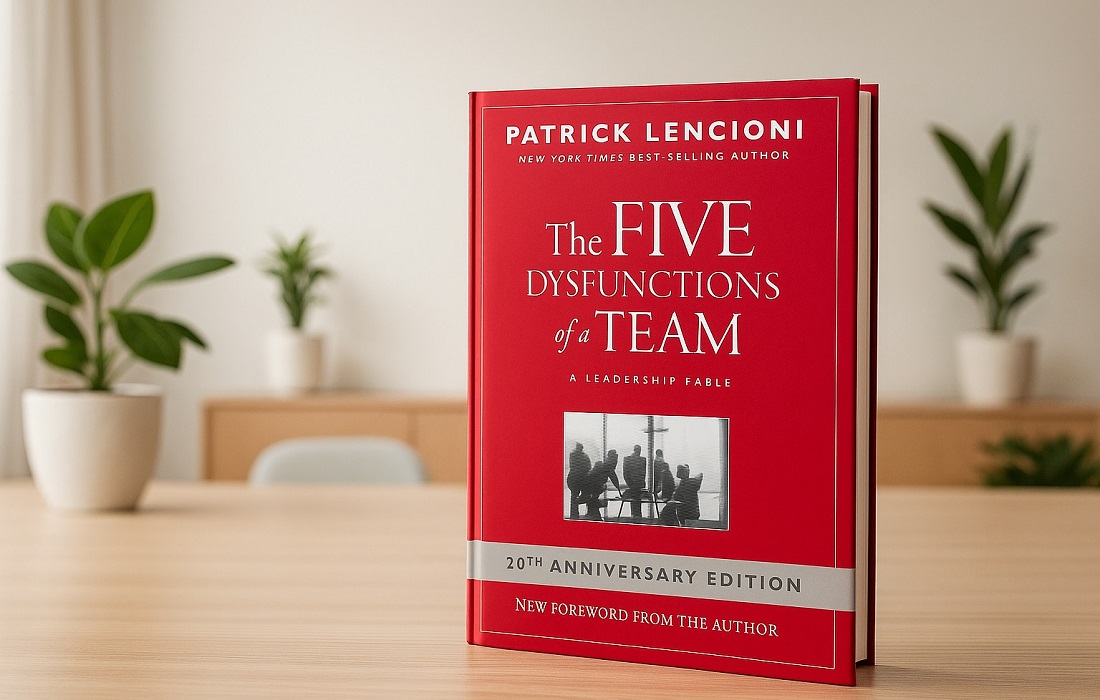
The Five Dysfunctions of a Team: A Leadership Fable by Patrick M. Lencioni blends a compelling fictional corporate turnaround story with a clear, actionable framework for building cohesive, high‑performing teams. Through the struggles of DecisionTech’s executive group under new CEO Kathryn Petersen, Lencioni reveals the five core behaviors essential for success: trust, constructive conflict, commitment, accountability, and focus on results. Using relatable characters and realistic challenges, The Five Dysfunctions of a Team by Patrick M. Lencioni illustrates how dysfunctions undermine performance and offers practical steps to reverse them. This timeless guide has become a management classic, equipping leaders across industries to transform teams into unified forces for lasting achievement.
1. Introduction to The Five Dysfunctions of a Team by Patrick M. Lencioni
The Five Dysfunctions of a Team by Patrick M. Lencioni is one of the most widely read works on teamwork and leadership in organizational life. First published in 2002, it blends a fictional corporate case study (“the fable”) with a concise, practical model for diagnosing and repairing broken teams.
The premise is deceptively simple: teams, made up of intelligent and capable individuals, fail not because of a lack of resources or intelligence, but because of predictable, interrelated behavioral shortcomings. These “five dysfunctions” are arranged in a pyramid, each layer underpinning the next. If the foundation is weak, the subsequent levels collapse.
Lencioni’s work is grounded in years of consulting with executive teams, and it seeks to bridge the gap between hard strategy and the interpersonal dynamics that often sabotage execution. Its dual format – storytelling followed by analysis and tools – allows readers to both experience the principles through relatable characters and then directly apply the model in their own organizations.
+ Top 10 Books About Leadership for Beginners
2. Author Biography
Patrick M. Lencioni (b. 1965) is the founder and president of The Table Group, a management consulting firm specializing in organizational health and executive team development. Over the last two decades, Lencioni has become one of the most influential authors in the field of leadership, repeatedly featured in Fortune, Harvard Business Review, The Wall Street Journal, and numerous business media outlets.
Before starting The Table Group, Lencioni worked as an executive for Sybase, Oracle, and Bain & Company. His consulting and keynote speaking engagements focus on creating cohesive leadership teams, building organizational clarity, and sustaining healthy cultures. His distinctive style blends narrative clarity, humor, and accessible frameworks, making his concepts easy to grasp and transmit across all levels of an organization.
Beyond The Five Dysfunctions of a Team, Lencioni has authored The Advantage, The Ideal Team Player, Death by Meeting, and other fable‑based leadership books. His method – narratives illustrating leadership principles, followed by explicit models – is now a hallmark of his brand.
3. Structure of The Five Dysfunctions of a Team by Patrick M. Lencioni
The book is divided into two main sections:
The Fable: A fictional case study about DecisionTech, a struggling Silicon Valley startup, and its new CEO, Kathryn Petersen. Through her leadership journey, we watch each dysfunction surface and be addressed.
The Model: A direct, non‑fiction section that explains the five dysfunctions in detail, the logic of their pyramid structure, assessment methods, and tools for overcoming them.
4. The Fable: DecisionTech’s Turnaround
4.1 Setting the Stage: Kathryn’s Arrival
DecisionTech was once one of Silicon Valley’s most promising startups, boasting elite talent, top investors, and enviable funding. But its meteoric rise stalled; deadlines slipped, morale eroded, and reputation declined. The board replaced founder‑CEO Jeff Shanley with Kathryn Petersen, an outsider with deep operational and manufacturing experience but no “tech glamour.”
From the outset, Kathryn faces skepticism: she’s older than the typical Valley executive, educated at a state school, and perceived as culturally misaligned with DecisionTech’s casual, hoodie‑wearing ethos. But the Chairman trusts her – she has a known gift for building effective teams.
4.2 Early Observations
Kathryn spends her first weeks quietly attending executive meetings, resisting the urge to make immediate changes. She sees the dysfunction firsthand:
– Meetings are orderly but unproductive.
– Executives avoid healthy debate and leave conflicts unresolved.
– There’s no unified commitment to decisions.
– Some executives openly undermine each other.
– Accountability is lax, and results are slipping.
4.3 The Napa Retreat: Confronting Reality
Kathryn calls a two‑day offsite in Napa Valley. The executives expect strategy talks; instead, Kathryn focuses on team behavior. She introduces the five dysfunctions model and challenges them to match these dysfunctions to their own behaviors. Resistance, discomfort, and defensiveness ensue.
Her central message: unless the leadership team becomes functional, no amount of strategy will succeed. The dysfunctions are:
- Absence of Trust: fear of being vulnerable with the group.
- Fear of Conflict: avoidance of productive, passionate debate.
- Lack of Commitment: ambiguous agreements and weak buy‑in.
- Avoidance of Accountability: reluctance to call out peers on behaviors or performance.
- Inattention to Results: focus on personal or departmental success over collective outcomes.
4.4 Building Trust
Trust is not simply “getting along”; it’s vulnerability‑based trust – openly admitting mistakes, weaknesses, and asking for help. Kathryn leads exercises where team members share personal histories, challenges, and mistakes. These moments reduce guardedness and create a baseline of empathy.
4.5 Encouraging Conflict
With trust established, Kathryn works to normalize constructive disagreement. She models acceptance of dissent, pushes for clarity of differing opinions, and reframes conflict as a pursuit of the best answer, not personal attacks. Over time, meetings become less artificially polite and more productively passionate.
4.6 Driving Commitment
Kathryn insists on clear decisions and buy‑in at the end of discussions. Even executives who disagree are asked to support the final decision in public. She emphasizes that clarity and closure beat consensus when speed matters.
4.7 Enforcing Accountability
Peer‑to‑peer accountability is reinforced through explicit goals, metrics, and public commitments. Kathryn makes it clear: the CEO cannot be the only one holding people to account. The team must self‑police to maintain standards.
4.8 Focusing on Results
The final step is collective results. Kathryn aligns incentives, updates scoreboards, and regularly links team discussions back to measurable organizational priorities. She confronts behavior where department‑level wins are prioritized over company success.
4.9 Outcome
Over several months, DecisionTech’s leadership team develops genuine trust, debates vigorously, commits to unified courses of action, holds each other accountable, and pursues shared results. The cultural shift slows turnover, improves morale, and begins to reverse performance decline – proof that behavioral transformation can be as decisive as strategy or capital.
5. The Five Dysfunctions Model
The Five Dysfunctions of a Team by Patrick M. Lencioni ‘s model is visualized as a pyramid with trust at its base and results at its apex. Each dysfunction corresponds to a fundamental building block of high‑performing teams.
5.1 Absence of Trust
– Definition: Unwillingness to be vulnerable; hiding weaknesses and mistakes.
– Impact: Prevents open exchange of ideas, seeking help, and admitting uncertainty.
– Remedies: Personal history sharing, personality/behavioral profiling, leader vulnerability modeling, feedback norms.
5.2 Fear of Conflict
– Definition: Desire to preserve artificial harmony; avoidance of passionate debate.
– Impact: Leads to veiled discussions, unclear decisions, and deferred issues.
– Remedies: Acknowledge conflict’s value, mine for disagreement, establish real‑time permission for debate.
5.3 Lack of Commitment
– Definition: Failure to clearly decide and unify behind decisions.
– Impact: Ambiguity, second‑guessing, slow execution.
– Remedies: Cascading messaging after meetings, deadlines, contingency planning, worst‑case scenario analysis.
5.4 Avoidance of Accountability
– Definition: Reluctance to confront peers about counterproductive behaviors or missed commitments.
– Impact: Erodes respect, allows subpar performance, weakens morale.
– Remedies: Public goals, progress reviews, regular accountability meetings, peer pressure culture.
5.5 Inattention to Results
– Definition: Prioritizing personal/departmental success, status, or ego over team outcomes.
– Impact: Stagnation, decline in competitiveness, demotivation of high performers.
– Remedies: Public scoreboards, collective rewards, regular review of results.
6. Interconnection of the Dysfunctions
The pyramid is interdependent:
– Without trust, conflict is feared.
– Without conflict, commitment is weak.
– Without commitment, accountability is avoided.
– Without accountability, results suffer.
This cascading effect ensures that neglecting a foundational dysfunction undermines all layers above it.
7. Application and Tools
The Five Dysfunctions of a Team by Patrick M. Lencioni includes:
– The Team Assessment: A survey scoring each dysfunction to identify focus areas.
– Action Steps: Practical exercises like role‑playing conflict, setting quarterly collective goals, and rotating peer evaluation.
– Leader’s Role: Modeling vulnerability, encouraging healthy dissent, enforcing clarity, challenging excuses, and celebrating collective wins.
8. Broader Implications
While The Five Dysfunctions of a Team by Patrick M. Lencioni centers on executive teams, Lencioni emphasizes that the model applies across all team contexts – from non‑profits to sports teams to educational leadership groups. Organizational culture magnifies from the top down; a dysfunctional leadership team inevitably infects the whole company.
In the broader management literature, The Five Dysfunctions aligns with research on psychological safety, commitment bias, and collective efficacy. Where some models lean on personality theory, Lencioni’s stays strictly behavioral, making it universally applicable.
9. Critiques and Limitations
Common academic critiques include:
– Anecdotal Evidence: The model is narrative‑driven, not presented as statistically validated research.
– Binary Framing: Real‑world teams may experience “partial” functionality that doesn’t strictly fit a pyramid model.
– Context Sensitivity: Startup cultures differ from government agencies; application often requires tailoring.
Nonetheless, its enduring popularity suggests its resonance and practical value outweigh these concerns for many practitioners.
10. Conclusion: The Five Dysfunctions of a Team by Patrick M. Lencioni
Two decades after publication, The Five Dysfunctions of a Team by Patrick M. Lencioni remains a staple in leadership training, MBA programs, and corporate offsites. Its strength lies in:
– A memorable, intuitive model.
– A vivid fictional narrative showing the principles in action.
– Practical, replicable tools adaptable to diverse contexts.
In the larger canon of management thought, Lencioni’s work underscores that sustainable performance stems not merely from strategy and technical skill, but from trust, accountability, and shared purpose – the human foundations of teamwork.
If you found this summary helpful, please share it or leave a comment below.