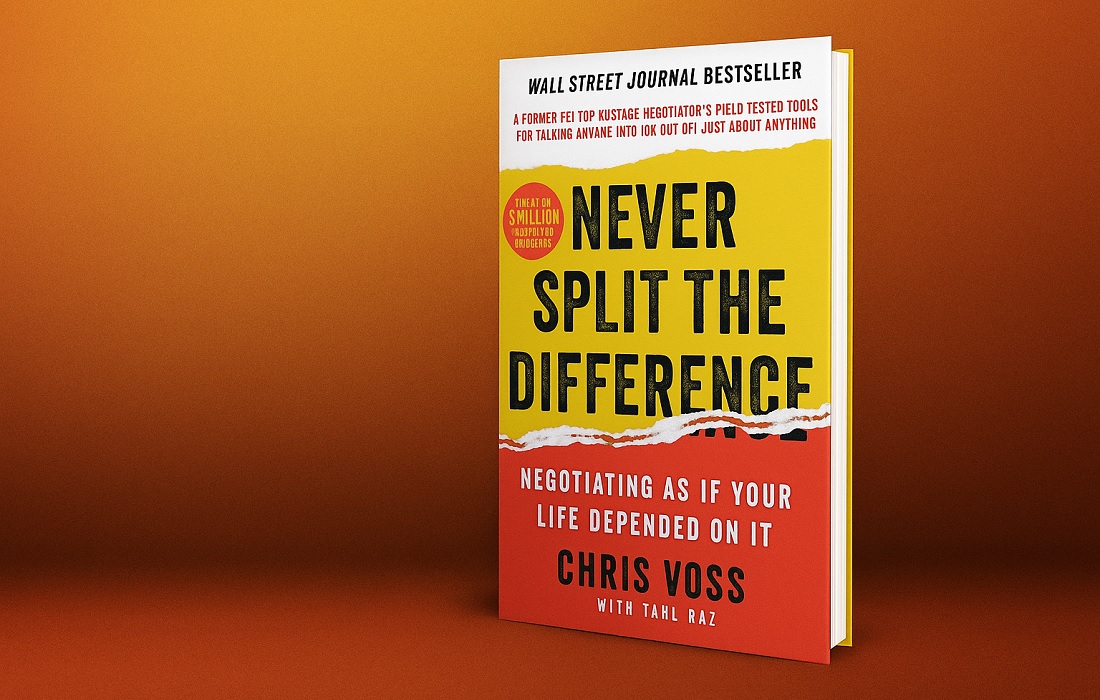
Never Split the Difference: Negotiating as if Your Life Depended on It by Chris Voss is a masterclass in negotiation drawn from the author’s 24 years as the FBI’s lead international hostage negotiator. Blending gripping real‑world cases with actionable strategies, Never Split the Difference by Chris Voss reveals why compromise isn’t the path to success and why emotional intelligence is the ultimate tool in any high‑stakes discussion. Through concepts like Tactical Empathy, calibrated questions, and discovering “Black Swans,” he equips readers to influence outcomes in business, personal, and everyday negotiations. This book transforms negotiation from a dreaded chore into a practical, relationship‑building skill that ensures you achieve your goals without giving away what matters.
1. Introduction to Never Split the Difference by Chris Voss
Never Split the Difference by Chris Voss reframes negotiation from a cool, rational exercise in compromise to an emotionally attuned, high‑stakes conversation that hinges on empathy, psychology, and tactical influence. Drawing on a 24‑year career as the FBI’s lead international hostage negotiator and years of teaching negotiation at top business schools, Voss systematically dismantles conventional negotiation theory – especially the “splitting the difference” mentality – and replaces it with a set of tools designed to win without unnecessary concessions.
The book’s title is a warning: in life‑or‑death hostage negotiations, splitting the difference could mean losing lives. That same principle, Voss argues, applies to business deals, salary negotiations, sales agreements, parenting, and everyday disputes. The core message is that effective negotiation is not about cold logic or meeting halfway, but about deeply understanding the other party’s emotions and perceptions, guiding conversations toward desired outcomes, and creating agreements that feel mutually satisfying while achieving your non‑negotiable goals.
Structured with a balance of gripping real‑world stories, research‑backed strategies, and actionable tactics, Never Split the Difference is both a memoir of high‑pressure FBI work and a practical manual for anyone who needs to influence others – in other words, everyone.
2. Author Biography: Chris Voss
– Full Name: Christopher “Chris” Voss
– Early Life and Education: Born in 1957 in Mount Pleasant, Iowa. Earned a degree from Iowa State University, later completing further studies in the FBI and Harvard’s Program on Negotiation.
– Career in Law Enforcement:
– Joined the FBI in 1983.
– Served as lead international kidnapping negotiator for the FBI.
– Represented the U.S. at the National Security Council’s Hostage Working Group.
– Involved in high‑profile cases worldwide – from bank robberies in Brooklyn to kidnappings in the Philippines and Haiti.
– Transition to Business: After retiring from the FBI in 2007, Voss founded The Black Swan Group, a consulting firm that trains individuals and companies in negotiation.
– Teaching Roles: Adjunct professor at Georgetown University’s McDonough School of Business and University of Southern California’s Marshall School of Business.
Voss brings a distinctive blend of battlefield‑tested crisis intervention skills and sharp psychological insight into his civilian negotiation training.
3. Core Thesis and Approach
The central thesis in Never Split the Difference by Chris Voss is simple but profound: negotiation is not about abstract logic – it is about human beings, and human beings are driven primarily by emotion. Emotional regulation and empathy are not “soft skills”; they are the most potent levers in high‑stakes communication.
Voss’s approach centers on:
– Tactical Empathy: Understanding and verbalizing the other side’s feelings and perspective without necessarily agreeing.
– Active Listening: Using calibrated techniques such as mirroring, labeling, and strategic silence to draw out critical information.
– Psychological Framing: Steering the perceived context of a negotiation to influence decisions.
– Black Swan Discovery: Uncovering hidden pieces of leverage – unknown unknowns – that transform the balance of power.
4. Structure of the Book Never Split the Difference by Chris Voss
The book unfolds in ten chapters, each anchored by real cases and framed by one or more key techniques. Here is a breakdown with integrated content and synthesis:
Chapter 1 – The New Rules
Voss contrasts the Getting to Yes school of thought – cooperative, rational, and BATNA‑driven – with the messy reality of dealing with hostage‑takers in emotional crisis. In real life, you can’t meet a kidnapper halfway (“You keep two hostages, we’ll take the other two”). The “new rules” recognize that negotiation is a process of gaining emotional control, gathering information, and influencing behavior.
Key takeaways:
– Most negotiations are not rational problem‑solving interactions.
– The majority hinge on intense emotions and primal needs.
– Tactical empathy is central: negotiate with the emotional, intuitive part of the brain (System 1), not just the analytical (System 2).
Chapter 2 – Be a Mirror
Mirroring – the simple act of repeating the last few key words or ideas the other person just said – is a surprisingly potent rapport‑builder. It encourages the other side to elaborate, reveals information, and makes them feel heard.
Real‑world example:
– In a tense standoff, Voss uses mirroring to keep hostage‑takers talking, slowing escalation and creating openings.
Application:
– Use mirroring in business to get clients to reveal hidden constraints or unstated needs.
– Combine mirroring with tone control – Voss advises using the “Late‑Night FM DJ Voice” to signal calm and authority.
Chapter 3 – Don’t Feel Their Pain, Label It
Labeling means spotting and verbalizing the counterpart’s underlying emotions without judgment: “It sounds like you’re frustrated,” or “It seems like you feel disrespected.” This technique demonstrates understanding, builds trust, and often defuses negative affect.
Research roots:
– Drawn from clinical therapy and behavioral psychology, labeling reduces amygdala activation and fosters self‑reflection.
Case link:
– During a kidnapping overseas, Voss’s team used labeling to validate the captor’s grievances, lowering tension and moving negotiations forward.
Chapter 4 – Beware Yes, Master No
Most negotiators chase “yes,” assuming it signals agreement. Voss argues that “yes” can be meaningless – or worse, a false positive. “No,” by contrast, makes people feel safe and in control, and often opens the door to real problem‑solving.
Technique:
– Prompt a “no” to lower defenses: “Is now a bad time to talk?”
– See “no” as the start of negotiation, not its end.
Chapter 5 – Trigger the Two Words That Transform Any Negotiation
Aim for the counterpart to say, “That’s right.” This phrase means they feel fully understood. You get there through deep listening, summarizing their perspective accurately, and reflecting it back to them.
This is different from agreement (“You’re right”), which can be a polite escape route. “That’s right” signals genuine alignment.
Chapter 6 – Bend Their Reality
Drawing on behavioral economics (Prospect Theory, framing effects), Voss shows how to set perceptions of value and fairness to your advantage.
Tactics include:
– Anchoring Loss: Frame concessions as potential losses to create urgency.
– Odd Numbers: Specific figures feel more credible than round ones.
– Extreme Anchors: Start ambitiously to shift the discussion’s center of gravity.
– Use the “Fair” pivot: pre‑empt tension by invoking fairness (“I want to be fair…”).
Chapter 7 – Create the Illusion of Control
Through calibrated questions (“How…?” “What…?”), you prompt the other party to solve your problem. This engages their intelligence and autonomy while moving them toward your target outcome.
Advantages:
– Avoids yes/no dead ends.
– Indirectly asserts your constraints without confrontation.
Example:
– In a Harvard negotiation exercise, Voss secured a better outcome by asking, “How am I supposed to do that?” – prompting the other side to adjust their terms themselves.
Chapter 8 – Guarantee Execution
A verbal agreement is worthless without follow‑through. Voss outlines methods to ensure implementation:
– Use “How” questions to map next steps.
– Identify deal‑blockers not physically present.
– Get counterparts to articulate their own plan, increasing buy‑in and accountability.
Chapter 9 – Bargain Hard
When it comes to haggling, Voss teaches the Ackerman bargaining method (originally a CIA technique):
- Set your target price.
- Offer 65% of that figure.
- Increase to 85%, then 95%, before reaching 100%.
- Use empathy and psychological tactics between moves.
- End with a non‑monetary extra to make the counterpart feel they’ve won.
Chapter 10 – Find the Black Swan
Black Swans are hidden pieces of critical information that, once discovered, change the entire dynamic. Finding them requires curiosity, deep listening, and reading between lines.
Examples:
– A hostage‑taker’s secret vulnerability, personal deadline, or outside pressure.
– In business: unknown decision‑makers, hidden budget allocations, undisclosed constraints.
5. Theoretical Underpinnings and Psychological Foundations
Never Split the Difference by Chris Voss integrates concepts from:
– Daniel Kahneman’s System 1 and System 2 thinking.
– Prospect Theory: people fear losses more than they seek equivalent gains.
– Game Theory: finding stable strategies in repeated encounters.
– Therapeutic Listening Research: labeling and summarizing to reduce defensiveness.
6. Case Studies and Applications
Throughout the book, Voss’s stories provide both drama and proof of concept:
– Brooklyn Bank Robbery (1993): His first on‑scene hostage negotiation – testing empathy‑driven methods rather than force.
– Philippines Kidnappings: Building rapport with dangerous captors, using pauses and labeling to prevent escalation.
– Business Negotiations: From securing favorable client contracts to helping executives close multi‑million‑dollar deals using calibrated questions.
– Domestic Scenarios: Persuading a child to go to bed or a partner to agree on a purchase by reframing the conversation.
7. Critiques and Misconceptions
Critics of Voss’s style sometimes suggest:
– Overreliance on psychological tactics could feel manipulative if applied without sincerity.
– High‑pressure crisis models may not always translate directly to low‑stakes settings.
Voss counters that tactical empathy is not manipulation, but information gathering plus relationship building, and can be adapted to scale.
8. Enduring Value and Practical Use
Never Split the Difference by Chris Voss durability as a negotiation manual comes from its fusion of:
– Compelling storytelling to make techniques memorable.
– Concrete steps applicable in diverse contexts.
– Psychological insight that feels both authoritative and human.
In business, Never Split the Difference has influenced sales teams, entrepreneurs, project managers, and HR professionals. In personal life, its methods help in resolving domestic disputes and making everyday transactions smoother.
9. Key Lessons Recap
- Stay emotionally grounded. Negotiation success rises with emotional control.
- Mirror and label. Simple language tools can transform dynamics.
- Get to “no.” Control comes from safety, not pressure.
- Aim for “That’s right.” Demonstrating deep understanding is more powerful than agreement.
- Bend reality. Frame loss and fairness to steer outcomes.
- Use calibrated questions. Influence without cornering.
- Plan implementation. The deal’s value is realized in execution.
- Structure bargaining. Use process, not impulse, for concessions.
- Hunt for Black Swans. Unknown facts can redefine the game.
10. Conclusion: Never Split the Difference by Chris Voss
Never Split the Difference by Chris Voss redefines negotiation as a fundamentally human art: one that depends not on spreadsheets, ultimatums, or splitting the difference, but on listening, empathy, and psychological precision. Chris Voss shows that anyone – from Wall Street dealmakers to parents – can negotiate more effectively by understanding how people actually think, feel, and decide.
Whether the stakes are life‑and‑death or simply the terms of a business deal, Voss’s methods offer a path to secure results that matter, preserve relationships, and leave both sides feeling they’ve won – all without sacrificing your core objectives.
If you found this summary helpful, please share it or leave a comment below.