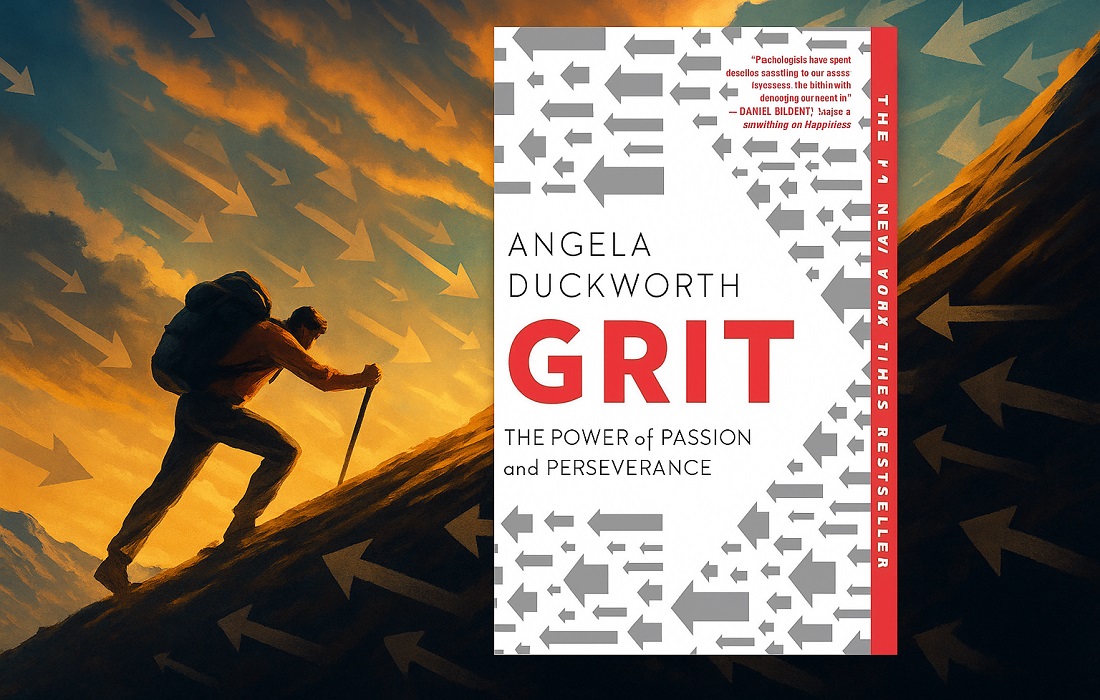
Grit by Angela Duckworth explores the science and stories behind extraordinary achievement, revealing why passion and perseverance often outweigh raw talent. Drawing from research across military training, education, athletics, and business, Angela Duckworth shows how grit—a unique blend of long-term commitment and relentless effort—predicts success across diverse fields. This summary distills her insights on how interest, deliberate practice, purpose, and hope form the foundation of grit, and how supportive environments can nurture it. Readers will discover actionable strategies to strengthen their own perseverance, reframe setbacks, and align their passions with meaningful goals to achieve lasting excellence.
1. Introduction to Grit by Angela Duckworth
Published in 2016, Grit: The Power of Passion and Perseverance swiftly became a bestseller and a touchstone in discussions of achievement, resilience, and character. Angela Duckworth, a psychologist and former teacher, synthesizes years of research into the single quality she believes is the most reliable predictor of long-term success: grit – a blend of passion and sustained perseverance toward long-term goals.
Duckworth’s thesis challenges both the “natural talent” narrative and short-term motivational fads. Her extensive studies – from military training and high school graduation rates to sales performance and spelling bees – reveal that, while ability is important, effort counts twice in determining achievement. Effort drives both skill acquisition and the translation of skill into accomplishment.
The book blends empirical research, personal stories, case studies, and practical strategies, designed not just to explain grit as a concept but to show how it can be cultivated individually and socially.
2. Author Biography – Angela Duckworth
– Full Name: Angela Lee Duckworth
– Born: 1970, United States
– Background: Daughter of immigrants from China; raised in Cherry Hill, New Jersey. Her father often remarked that she was “no genius,” a formative refrain that sparked her lifelong interest in understanding achievement.
– Education:
– BA in Neurobiology, Harvard University
– MS in Neuroscience, University of Oxford as a Marshall Scholar
– PhD in Psychology, University of Pennsylvania
– Career: Began as a McKinsey & Company consultant, left to teach math in New York public schools and at a selective San Francisco high school, before becoming a researcher and professor at the University of Pennsylvania.
– Current roles: Founder and CEO of Character Lab (a nonprofit promoting the science and practice of character development); 2013 MacArthur “Genius Grant” recipient. Known globally for her TED Talk on grit, which has garnered millions of views.
3. Core Thesis
Grit by Angela Duckworth core argument: Talent alone does not guarantee success. True, sustained achievement relies more on grit – the combination of long-term passion and perseverance – than on innate ability.
She underscores that:
– Grit and talent are distinct: While correlated in some contexts, high talent does not necessarily mean high grit.
– Effort compounds: Effort is crucial in developing skill, and then again in applying skill toward meaningful achievement.
– Grit is learnable: While partly shaped by genetics and early environment, grit can be deliberately cultivated through mindset, habits, and supportive culture.
4. Structure and Detailed Summary
Preface
Duckworth opens with her father’s repeated statement, “You’re no genius,” juxtaposed against her winning the MacArthur Fellowship (“genius grant”). She explains that this book distills her scientific journey into understanding why some people accomplish more than others, even when starting with similar talent levels.
PART I – What Grit by Angela Duckworth Is and Why It Matters
Chapter 1: Showing Up
Duckworth begins with West Point’s grueling “Beast Barracks” training. Despite cadets’ impressive credentials – athleticism, grades, leadership – about 20% quit during Beast. West Point’s Whole Candidate Score statistically predicts talent but not perseverance. Duckworth’s Grit Scale, however, successfully forecasts who would endure.
Her takeaway: Persistence under hardship is a better long-term predictor than any traditional measure of ability. This pattern repeats in other domains, such as high-pressure sales jobs and urban school graduation rates.
Chapter 2: Distracted by Talent
From her time as a teacher, Duckworth recounts observing that natural aptitude didn’t guarantee academic achievement – in fact, some “gifted” students underperformed due to lack of sustained effort, while less naturally talented but hardworking students thrived. She warns against the “naturalness bias,” our cultural overvaluation of effortless talent over disciplined practice.
This idea builds on historical perspectives, from Francis Galton’s studies on eminence to Darwin’s assertion that zeal and hard work surpass innate intelligence in importance.
Chapter 3: Effort Counts Twice
Duckworth introduces her “Effort Counts Twice” equation:
- Talent × Effort = Skill
- Skill × Effort = Achievement
Talent accelerates skill acquisition, but without effort, talent remains latent. Superior performance is primarily a product of much more total effort – both in developing the skillset and applying it toward long-term objectives.
Chapter 4: How Gritty Are You?
She presents the self-assessment Grit Scale, measuring consistency of interests and perseverance of effort. Grittier individuals tend to maintain commitments over years despite setbacks. Her data reveal that grit correlates with age, suggesting it accumulates through experience, but also that it varies significantly within age groups, indicating environmental influence.
Chapter 5: Grit Grows
Duckworth outlines the dual nature of grit’s origins:
– Nature (genetics): Temperament, baseline conscientiousness, natural interests.
– Nurture: Cultural influences, upbringing, opportunity, and deliberate choices.
She emphasizes personal agency in strengthening grit – while acknowledging biological starting points, habits and perspective shifts can significantly amplify perseverance and passion.
PART II – Growing Grit from the Inside Out
Internal cultivation requires working at four psychological “building blocks” – Interest, Practice, Purpose, and Hope – often in sequence.
Chapter 6: Interest
Passion begins with interest. Gritty individuals sustain engagement because they genuinely enjoy their domain. Interest emerges through exploration and is deepened by experiences of flow, curiosity, and positive reinforcement. Duckworth encourages deliberate exposure to varied activities to discover personal sparks.
Chapter 7: Practice
Once interest takes root, skill growth demands deliberate practice – concentrated effort targeting weaknesses, with clear goals and immediate feedback. Borrowing from Anders Ericsson’s expertise research, Duckworth stresses daily commitment to disciplined repetition, not mindless drills.
Chapter 8: Purpose
Passion is further amplified when linked to purpose – a broader contribution beyond personal gain. Many high achievers integrate their skills into work that benefits others, aligning personal satisfaction with social value. This meaning sustains motivation through inevitable challenges.
Chapter 9: Hope
Duckworth defines grit’s hope as perseverance through difficulty with belief in improvement, distinct from passive optimism. This growth-oriented hope fuels persistence in the face of failures, reframing setbacks as opportunities for learning rather than signs to quit.
PART III – Growing Grit from the Outside In
Beyond individual mindset, grit is profoundly shaped by social and cultural environments.
Chapter 10: Parenting for Grit
Duckworth’s research shows that supportive yet demanding parenting fosters grit. The “wise parenting” style blends high expectations with emotional support, modeling perseverance and guiding children through challenges without rescuing them prematurely.
Chapter 11: The Playing Fields of Grit
Sports, extracurriculars, and structured challenges act as grit-training grounds by requiring commitment, discipline, and resilience. Duckworth advocates for youth participation in at least one sustained extracurricular, where quitting before a set finish line is discouraged.
Chapter 12: A Culture of Grit
Organizations – from sports teams to companies – can embed values that inspire persistence. Shared norms, mission-driven work, and leadership that models tenacity all reinforce grit among members. Cultural expectations amplify individual willpower, making perseverance the group standard.
Chapter 13: Conclusion (Final Thoughts)
Duckworth ends by reiterating that grit matters in nearly all demanding pursuits, but it is not the only trait needed – qualities like kindness, fairness, and creativity also count. Her hope is that understanding grit empowers readers to cultivate it deliberately in themselves and others, transforming potential into lasting achievement.
5. Key Insights from Research and Case Studies
Duckworth’s most significant empirical findings include:
- West Point & Beast Barracks: Grit predicted retention better than any aptitude score.
- Sales Industry: Persistence outweighed personality traits in predicting who stayed through rejection-heavy roles.
- Chicago Public Schools: Grit outperformed measures of conscientiousness, safety perception, or school interest in predicting graduation.
- Green Berets Selection: Trainees with high grit endured beyond those equally fit but less mentally persistent.
- National Spelling Bee: Gritty contestants practiced more hours and competed more often, leading to better results regardless of verbal IQ.
- Ivy League Studies: SAT correlated inversely with grit; students with slightly lower test scores often compensated with higher perseverance.
6. Critiques and Nuances from Broader Research
Internet-sourced critiques add nuance:
– Some researchers argue Duckworth slightly overstates grit’s independence from conscientiousness, as they often overlap statistically.
– Others caution against seeing grit as a cure-all – systemic inequality, resource access, and institutional bias strongly shape opportunities for perseverance to pay off.
– Duckworth herself concedes that extreme persistence in the wrong domain can be counterproductive; knowing when to quit unproductive efforts is part of long-term strategy.
7. Practical Applications
- In Education: Extend commitment structures for students (clubs, projects) to build discipline and resilience.
- In Workplaces: Hire for and nurture grit via goal-setting, feedback loops, and mission-driven culture.
- For Personal Development: Identify passion, embed deliberate practice into routine, connect to meaningful purpose, and foster hope through reframing and self-compassion.
8. Conclusion
Grit by Angela Duckworth reframes how we think about success stories: not as products of rare talent or lucky breaks alone, but as the slow, sustained result of passionate commitment in the face of difficulty. Duckworth’s message – effort counts twice – is both empowering and sobering, requiring us to replace quick-win fantasies with long-haul discipline.
In blending personal narrative, rigorous science, and actionable strategies, the book offers both explanation and inspiration. While not without its methodological critiques, the enduring value lies in its reminder that sustained progress – in careers, academia, sports, the arts – rarely comes from brilliance alone. It is passion over years, courage over setbacks, and persistence over comfort that define the gritty path to mastery.