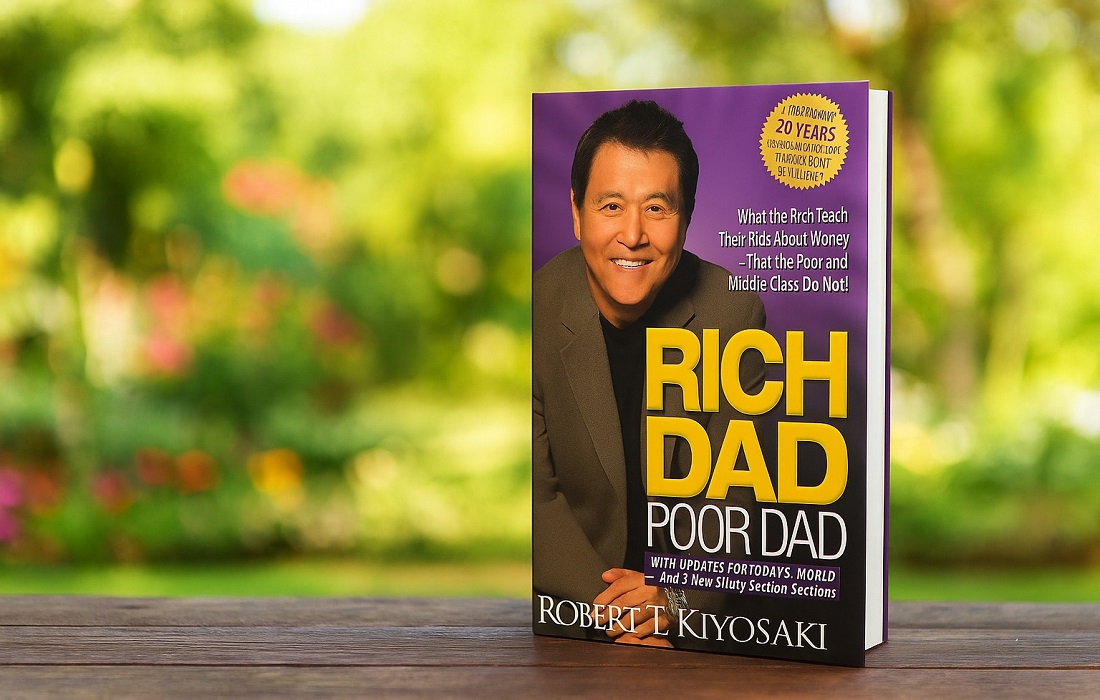
Rich Dad Poor Dad by Robert T. Kiyosaki (full title Rich Dad Poor Dad: What the Rich Teach Their Kids About Money That the Poor and Middle Class Do Not!) is more than a personal finance book; it’s a call to transform the way we think about money, work, and wealth. Drawing from the contrasting lessons of two father figures, Kiyosaki reveals how mindset, financial literacy, and strategic investing determine long-term success far more than academic achievement or job titles. Through engaging storytelling and practical concepts like assets vs. liabilities, the “rat race,” and making money work for you, this timeless guide empowers readers to take control of their financial future and create lasting freedom through informed, intentional wealth-building.
1. Introduction to Rich Dad Poor Dad by Robert T. Kiyosaki
First published in 1997 and subsequently updated in multiple editions, Rich Dad Poor Dad by Robert T. Kiyosakid is a personal finance classic that challenges conventional wisdom about money, education, and wealth creation. Through the contrasting financial philosophies of two father figures – the author’s biological father (“Poor Dad”) and his best friend’s father (“Rich Dad”) – Robert Kiyosaki delivers a narrative that blends memoir and practical guidance.
The book’s core objective is to show that financial literacy, not high income, determines long-term wealth. Where Poor Dad (Kiyosaki’s biological father) teaches the traditional formula – study hard, get a good job, work for security, and save – Rich Dad advocates acquiring assets, making money work for you, and taking control of one’s financial destiny.
Across its lessons, Kiyosaki emphasizes:
– The mindset shift from employee to investor/business owner.
– Understanding financial statements and assets vs. liabilities.
– Leveraging entrepreneurship and investments to escape the “rat race.”
– Mastering emotional intelligence around fear and greed in money decisions.
2. Author Biography: Robert T. Kiyosaki
– Born: April 8, 1947, Hilo, Hawaii, USA
– Background: Fourth-generation Japanese-American. Served as a U.S. Marine Corps helicopter gunship pilot in the Vietnam War. Later pursued business ventures in nylon wallets, retail, and educational companies.
– Career: Author of over 26 books in the “Rich Dad” series, translated into more than 50 languages, with over 41 million copies sold worldwide. Known for his brand of financial education through games (e.g., CASHFLOW 101) and seminars.
– Entrepreneur & Educator: Focuses on teaching concepts often omitted in traditional schooling – investing, passive income, leverage, and risk management.
– Controversy: Some critics question the literal existence of “Rich Dad” (Kiyosaki claims he was a composite figure), but the book’s influence on personal finance education is uncontested.
3. Core Concepts and Purpose of Rich Dad Poor Dad
Kiyosaki’s thesis: Building wealth requires shifting from working for money to making money work for you, which demands financial education, asset acquisition, and entrepreneurial thinking.
This involves:
- Challenging the conventional path of education → job → security.
- Acquiring assets that generate income, rather than relying on wages.
- Understanding money as an idea, not just currency.
- Escaping the “rat race” where expenses rise with income but wealth stagnates.
4. Overview of Structure
The book is built around six main lessons (drawn from decades of mentorship from Rich Dad) plus additional chapters on overcoming obstacles and getting started:
- The Rich Don’t Work for Money
- Why Teach Financial Literacy?
- Mind Your Own Business
- The History of Taxes and the Power of Corporations
- The Rich Invent Money
- Work to Learn – Don’t Work for Money
Supplementary sections cover:
– Overcoming fear and cynicism.
– Starting the journey toward wealth.
– Actionable “to-do” lists for readers.
5. Detailed Lesson-by-Lesson Summary of Rich Dad Poor Dad
Lesson 1 – The Rich Don’t Work for Money
Kiyosaki recalls being nine years old, eager to learn how to be rich. His best friend Mike’s father (“Rich Dad”) offers a counterintuitive apprenticeship: work for free to force them to use creativity to generate income. This leads to their first venture – a comic book library stocked with discarded comics – which earns money without their direct labor.
Main takeaways:
– Employees exchange time for money; the rich focus on assets that generate recurring income.
– Fear and desire (greed) trap people: fear of being without money drives job dependency; desire drives consumption.
– Breaking free requires asking, “Is there another way?” rather than accepting security.
Lesson 2 – Why Teach Financial Literacy?
Core principle: It’s not how much you make, it’s how much you keep – and how hard that money works for you.
– Defines assets as things that put money in your pocket and liabilities as things that take money out.
– Common mistake: considering personal residences as assets; unless it generates income, it’s a liability.
– Building wealth means focusing on acquiring income-generating assets: rental properties, businesses, stocks, intellectual property.
– Poor and middle-class households often gain income but spend it on expenses and liabilities, never escaping the paycheck cycle.
Lesson 3 – Mind Your Own Business
This lesson challenges readers to focus on building their own asset base, even if employed.
– “Mind your own business” means prioritizing personal investments over depending solely on an employer.
– Many professionals earn high incomes but remain financially insecure because they rely entirely on jobs and retirement plans.
– Kiyosaki encourages reinvesting earnings into portfolios that compound wealth independent of wage labor.
Lesson 4 – The History of Taxes and the Power of Corporations
Historical insight:
– Taxes initially targeted the wealthy but evolved into a burden on the middle class.
– Wealthy individuals use corporations as legal entities to reduce taxes, protect assets, and reinvest pre-tax income.
– Understanding corporate structures and tax laws allows leveraging the system legally – something schools rarely teach.
Rich Dad’s formula:
- Earn income in a corporation.
- Deduct expenses.
- Pay taxes on what remains – often far less than the individual rate.
Lesson 5 – The Rich Invent Money
– Opportunities are everywhere, but financial education is required to spot them.
– Leverage: using other people’s money, resources, or talents to create profits.
– The poor and middle class often believe you need money to make money; the wealthy understand that ideas and knowledge are the real starting capital.
– Examples: acquiring underpriced assets, creating intellectual property, or business arbitrage.
Lesson 6 – Work to Learn – Don’t Work for Money
– Job choices should be based on the skills gained, not the salary.
– Ferriss-like cross-training: learn sales, marketing, investing, management.
– Build a skill set that allows you to create and manage multiple income streams.
– Kiyosaki’s own journey included joining Xerox to master sales before transitioning to entrepreneurship.
6. Overcoming Obstacles
Rich Dad Poor Dad by Robert T. Kiyosaki identifies five main barriers to wealth:
- Fear – leads to inaction and paralysis.
- Cynicism – skepticism without analysis blocks opportunity recognition.
- Laziness – often disguises itself as busyness.
- Bad Habits – spending before investing.
- Arrogance – believing you know enough and refusing to learn more.
His advice:
– Neutralize fear with education and small, calculated risks.
– Replace passive doubt with active due diligence.
– Automate good financial habits (e.g., “pay yourself first” by investing before paying expenses).
7. Getting Started: The Rich Dad Action Plan
Practical starting points:
– Find a reason greater than reality – a personal “why” that drives discipline.
– Choose daily habits that channel money into assets consistently.
– Master one investment type at a time – whether real estate, stocks, or intellectual property.
– Learn from others – mentors, books, and courses can shorten learning curves.
– Take baby steps – even small investments build financial confidence.
8. Integration of Internet Sources & Cultural Impact
From external research:
– Rich Dad Poor Dad has sold over 41 million copies in 51 languages (source: Business Insider, 2023).
– It popularized financial literacy terms like “rat race” and “passive income.”
– Influence: spurred “cashflow clubs” and inspired generations to pursue real estate investing, e-commerce, and entrepreneurship.
– Criticism: personal anecdotes sometimes lack verifiable proof; some view its lessons as simplistic for those already financially literate.
– Praise: accessible, motivational, and life-changing for millions lacking financial education.
9. Philosophical Underpinnings
The book is tied to:
– Self-reliance – reject dependence on employers/government for security.
– Lifelong learning – actively seek financial and entrepreneurial skills.
– Mindset shift – see money as a tool, not a goal.
– Calculated risk-taking – wealth comes from venturing where others hesitate.
10. Contemporary Relevance
Today, with:
– The rise of digital entrepreneurship,
– Global remote work and gig economies,
– Broader access to investing tools (apps, online brokerages),
Kiyosaki’s principles resonate even more. However, the democratization of investing also means modern readers must adapt his 1997 frameworks to contemporary markets (e.g., cryptocurrencies, SaaS businesses).
11. Conclusion
Rich Dad Poor Dad by Robert T. Kiyosaki is not a step-by-step investment manual; it is a mindset manual. Kiyosaki dismantles the myth that academic success guarantees financial security, replacing it with the argument that financial intelligence and asset-building are the true determinants of wealth.
Its enduring appeal lies in its storytelling, easy-to-grasp definitions (assets vs. liabilities), and actionable encouragement to take control of one’s financial future.
For some, it opens the door to investing and entrepreneurship; for others, it reinforces existing beliefs about self-direction. Regardless, its cultural impact is undeniable, making it a cornerstone of modern personal finance literature.
If you found this summary helpful, please share it or leave a comment below.